

The U.S. is the biggest consumer of weight loss products but yet we are the most obese nation in the world. Why is that?
Look at the ingredients of weight loss products, most of them contain High Fructose Corn Syrup. The FDA will tell you that the body processes this ingredient no differently than regular sugar. This is false. It processes it differently & stores in in the body as fat, it doesn't use it for energy. 90% of the food you see in grocery stores today have high fructose corn syrup in them.
So, what is the number one way to get rid of fat? Don't eat or drink foods with High Fructose Corn Syrup in it. If you've seen the commercials for Losing it with Jillian (Jillian Michaels from the Biggest Loser), she says the same thing. I went thru our pantry & got rid of all the foods with high fructose corn syrup in it. Manufacturers are seeing that consumers don't want food with this ingredient in it & are starting to make foods without it, like Log Cabin pancake syrups & Hunt's Ketchup with their no High Fructose Corn Syrup Ketchup. Which if I may say, is the best ketchup I've ever tasted.
There are many diets out there for us to try. Weight Watchers, Jenny Craig, Hcg, Atkins, SlimFast, South Beach, Mediterranean, raw foods, etc. Depending on your budget, you may or may not be able to afford any of these & continue to struggle with weight loss or gain. Also, many can't afford a gym membership so this becomes a hurdle too.
So, what is an easy way to lose weight & stay within your budget? Well, after a lifelong batter with my own weight & seeing MANY members of my family in the same boat. I decided to take some info from one diet & some from another diet. Add in a little bit of will power & some good old fashioned sweat to see if it could be done.
I did it. I've lost 8.5 pounds in one week. How did I do it you may ask? Well, here is how I did it.
First off, I had to find my Calories burned at rest. Meaning, how many calories do I need just to sit here & read my computer screen. This also showed how many calories I needed just to maintain my current weight. I then could figure out how many calories I needed to take in each day to lose X amount of pounds per week. After searching all over the web, I came across the link below.
www.mycaloriecounter.blogspot.com
This had all the info I needed to give me a plan for losing weight. You input male or female, height & current weight. It then tells you how many calories you burn at rest, caloric intake to maintain your current weight, your current activity level & the calories taken in per day to either lose weight or gain weight. Even tho it told me to only take in 1,144 calories per day to lose 2.25 pounds per week, this daily caloric intake that I'm doing is resulting in a bigger weight loss. Which is a good thing.
Now, many foods tell you on the package that a number of ounces or grams is X amount of calories. What about chicken, beef & turkey? Nutritionist will tell you the size of a deck of cards. Well, there are 2 different sizes of a deck of cars. You have your regular playing cards or if you play UNO like I do, you have a deck of cards of over 100 cards. So, after more searching, I found this website that will tell you the calories in many foods & you can adjust the the portion size to what fits you best. There is a free membership & a paying membership. I've always been able to use the free membership.
www.calorieking.com
Its not just calories in, calories out. Your calories out needs to be GREATER than your calories in order to lose weight. Not only do you need to count calories BUT you also need to keep a food journal & keep track of everything you eat & the number of calories you take in each day so that you are sure you stay within your caloric budget. This makes for some difficult decisions when we want to eat our favorite foods, especially if its a special day during the week. Like I keep the Sabbath on Saturday & we have all sorts of goodies that are put out on this day. I have to make sure that I stay within my intake budget, even on the Sabbath.
Now, by now many of you are saying, diets are great but the biggest thing to overcome is the hunger between meals. Yes, this is hurdle BUT with will power & seeing the big picture & a little help from a ingredient our bodies are mostly made of, the hunger problem isn't that big of an issue.
You need to drink water & lots of it. The following info comes from the Hcg diet. You need to take your body weight & divide it by 2. This is how many ounces of water you should be taking in each day. Now some of you are looking at that number & saying, that is a LOT of water. What about water toxicity? The first few days that you are drinking that much water, you might get a headache or feel a little water logged, I know I did. BUT, it will pass. Now, if I don't drink that much water each day, I feel dehydrated. Some days I drink more than that because of I'm out doing my walking. As long as your are going to the bathroom, you shouldn't have any water toxicity problems.
Now, I just mentioned walking. There are various types of walks. There is a leisurely stroll, a quicker walk & then there is power walking. This is a fast deliberate walk in which you cover a good distance in a short amount of time. I do the power walking 6 days a week. I cover 2.5 miles in about 25 min. I take our dog with me since he also carrying a few extra pounds. My route for my power walking also goes by a number of neighborhood dogs so he learns to ignore them & concentrate on just walking or in his case its a trot for him.
If this rate continues, if I can stay with my will power & see the big picture at the end of the tunnel. Which in this case, is a new wardrobe & replacing our 25+ year old mattress set. I should be done to my goal weight by the end of July. YEAH!
Til next time friends,
Lori
Subscribe To

 Posts
All Comments
Posts
All Comments
Saturday, June 26, 2010


Sunday, May 2, 2010
BPPV Update
Wow, what a month. I've had 3 physical therapy treatments. The first one wasn't so bad, some dizziness with the movements designed to move the crystals out of the area where they are causing problems. The 2nd treatment was horrible. The room was spinning at times & one time when she sat me up, I felt like I was falling. The sensations were only supposed to last a few seconds, one lasted quite a few minutes. The 3rd one only resulted in a few episodes that only lasted a few seconds.
I wouldn't wish this on my worst enemy.
She said this could happen again in 6-18 months OR it could never occur again. I'm hoping its beyond the 6 month range since we will be in Illinois for the Feast of Tabernacles at the 6 month mark. Going to the ER while you are at the feast is NO FUN for anyone involved.
Working on a few health topics.
The Sun, sunblock lotion & skin cancer - What is the link?
Our toxic environment
Microwaves - How harmless are they?
My research class I took February thru March has really opened up a new relm of possibilities of topics & deeper research. I look forward to diving into these topics & typing up an article.
Til next time,
Lori
I wouldn't wish this on my worst enemy.
She said this could happen again in 6-18 months OR it could never occur again. I'm hoping its beyond the 6 month range since we will be in Illinois for the Feast of Tabernacles at the 6 month mark. Going to the ER while you are at the feast is NO FUN for anyone involved.
Working on a few health topics.
The Sun, sunblock lotion & skin cancer - What is the link?
Our toxic environment
Microwaves - How harmless are they?
My research class I took February thru March has really opened up a new relm of possibilities of topics & deeper research. I look forward to diving into these topics & typing up an article.
Til next time,
Lori
Tuesday, April 13, 2010
BPPV - Benign Paroxysmal Positional Vertigo
The days leading up to Passover on March 31st were hectic. Stressing in trying to get the house cleaned up, checking & double checking my guest list, trying to condense 5 workdays into 3 & planning the meal to be served that evening.
When I went to bed on the 30th, I never dreamed that the next morning would just about derail the whole day.
I set my alarm for 6:15 am. This would give me time to finish cleaning my kitchen & do a little baking for the Passover meal. During the short time my daughter would be in school, I could pick up a few things I needed from the store.
The alarm went off at 6:15, I rolled over to grab my cell phone (which was my alarm clock) & the room starting spinning instantly & the waves of nausea were unbearable. I staggered to the bathroom (about 20 feet from our bedroom) to splash cold water on my face, no help. I then made my way back to the bedroom, grasping door frames, chairs & whatever else could help me stay in an upright position. I collapsed back on the bed to try to gain some sort of control, again no help. The waves of nausea were becoming stronger & I had to run back to the bathroom to throw up. This continued for several hours. My hands, arms, legs & feet were cold & clamy but my core temp was normal.
I usually avoid the doctor like the plague but I knew if I didn't get any help soon that Passover would be a bust. My son drove me to the emergency room where I was I given Zofran for the nausea & Meclizine for the dizziness. After an hour, I could move around a little, as long as I didn't move too fast, without getting dizzy. I was finally discharged after being there for 2 1/2 hours.
The diagnosis - BPPV - Benign Paroxysmal Positional Vertigo
Basically what I've been told is that a certain population have crystals in their ears & that these crystals move up to a point in the ear & start stimulating the hair in the ear. This affects our balance & how our body feels in relation to our position.
http://www.physioworks.com.au/images/Injuries-Conditions/bppv.gif
Physical therapy, an exercise in movement to try to get the crystals down where they need to be OR to get the body used to the new position is an option for some. I start physical therapy on Thursday to try this exercise.
http://www.dizziness-and-balance.com/disorders/bppv/bppv.html
I visited my chiropracter last week & he found 3 vertebrae out of place. 2 in my upper back & 1 in my neck. When he pressed on the one in my neck it was instant pain. He said that was the one that was causing my vertigo problem. He popped it back into place & the room started spinning again. He said he would take a few minutes for it to clear up & not to drive home until I see clearly. (took about 20 minutes for things to clear up enough to head home)
I can drive but I have to be careful when I'm looking in both directions to check for traffic or to look to see if someone is sitting in blind spot if I'm changing lanes. The last 2 weeks of work have been interesting. I'm good for about 3 hours, anything beyond that & I start getting dizzy & sick to my stomach.
I'm looking forward to getting back to a normal life. With my busy lifestyle, I don't have time to be "down".
Til Next Time,
Lori
When I went to bed on the 30th, I never dreamed that the next morning would just about derail the whole day.
I set my alarm for 6:15 am. This would give me time to finish cleaning my kitchen & do a little baking for the Passover meal. During the short time my daughter would be in school, I could pick up a few things I needed from the store.
The alarm went off at 6:15, I rolled over to grab my cell phone (which was my alarm clock) & the room starting spinning instantly & the waves of nausea were unbearable. I staggered to the bathroom (about 20 feet from our bedroom) to splash cold water on my face, no help. I then made my way back to the bedroom, grasping door frames, chairs & whatever else could help me stay in an upright position. I collapsed back on the bed to try to gain some sort of control, again no help. The waves of nausea were becoming stronger & I had to run back to the bathroom to throw up. This continued for several hours. My hands, arms, legs & feet were cold & clamy but my core temp was normal.
I usually avoid the doctor like the plague but I knew if I didn't get any help soon that Passover would be a bust. My son drove me to the emergency room where I was I given Zofran for the nausea & Meclizine for the dizziness. After an hour, I could move around a little, as long as I didn't move too fast, without getting dizzy. I was finally discharged after being there for 2 1/2 hours.
The diagnosis - BPPV - Benign Paroxysmal Positional Vertigo
Basically what I've been told is that a certain population have crystals in their ears & that these crystals move up to a point in the ear & start stimulating the hair in the ear. This affects our balance & how our body feels in relation to our position.
http://www.physioworks.com.au/images/Injuries-Conditions/bppv.gif
Physical therapy, an exercise in movement to try to get the crystals down where they need to be OR to get the body used to the new position is an option for some. I start physical therapy on Thursday to try this exercise.
http://www.dizziness-and-balance.com/disorders/bppv/bppv.html
I visited my chiropracter last week & he found 3 vertebrae out of place. 2 in my upper back & 1 in my neck. When he pressed on the one in my neck it was instant pain. He said that was the one that was causing my vertigo problem. He popped it back into place & the room started spinning again. He said he would take a few minutes for it to clear up & not to drive home until I see clearly. (took about 20 minutes for things to clear up enough to head home)
I can drive but I have to be careful when I'm looking in both directions to check for traffic or to look to see if someone is sitting in blind spot if I'm changing lanes. The last 2 weeks of work have been interesting. I'm good for about 3 hours, anything beyond that & I start getting dizzy & sick to my stomach.
I'm looking forward to getting back to a normal life. With my busy lifestyle, I don't have time to be "down".
Til Next Time,
Lori
Friday, January 22, 2010
Plastics - How toxic are they?
Plastic - Its all around us. A lot of childrens toys are made out of plastic. We store our food in it, whether it be on the table or in the refrigerator & freezer. We drink liquids from it & we eat off of it. We even put food that is stored in plastic into the microwave to "heat" it up to eat it. The microwave is a whole blog topic on its own.
Lets look at each type of plastic & its toxicity.
#1 plastic - Polyethylene Terephthalate (PETE)
Uses: 2 liter soda bottles, cooking oil bottles, peanut butter jars.
This plastic was LONG considered to be one of the safest plastics to use as it was BPA (Bisphenol A). But, is this still true?
In a review done by Leonard Sax, PETE may leach endocrine disrupting phthalates. He considered evidence that the antimony from PET containers may lead to endocrine-disrupting effects.
Under what conditions do these chemicals leach into the product that is stored in them? Here is a list of "conditions" in which these chemicals are released into the product.
-Phthalates leach from the plastic into lower pH products such as soda & vinegar more readily than into bottled water
-Temperature also appears to influence the leaching both of phthalates (& antimony), with greater leaching at higher temperatures
-Combining both variations of low PH & high-heat exposure could result in an even higher leaching of phthalates
-Variations in the composition & manufacture of PET may also influence the leaching of these substances into the contents of the bottle. PET is typically a homopolymer, but some copolymers are also categorized as PET (copolymers have been found to be less vulnerable to degredation, thus leaching less)
Mr. Sax concludes that the evidence suggests PET bottles may yield endocrine disruptors under conditions of common use, particularly with prolonged storage and elevated temperature. Because of the widespread use of PET plastic worldwide, more research is needed to clarify how PET containers may be contaminated by endocrine-disrupting chemicals.
http://healthychild.org/blog/comments/pet_1_plastic_may_leach_endocrine_disruptors
#2 Plastic - High Density Polyethylene (HDPE)
Uses: detergent bottles, milk jugs.
This HDPE is one of the safer (notice I didn't say safest) & strongest plastic there is. Its opaque & harder for a reason, to withstand sunlight longer & last longer.
In researching this plastic, I was unable to find any real hazards. Of the 3 dozen or so articles I read, only 1 said that they took a drink from a #2 plastic & the drink tasted strongly of plastic.
Many articles showed that if you are going to have a water bottle, that a #2 water bottle is the way to go. As it replaces a #1 plastic that might leach chemicals into the liquid.
However, you want to avoid the Nalgene bottles made of Lexan that are more colorful. I did find one article in which it talked about BPA being leached into the liquid from this type of plastic. The article recommended going with a #2 type of plastic.
http://www.wta.org/trail-news/signpost/new-nalgene-safety-concern
#3 Plastic - Polyvinyl Chloride (PVC)
Uses: plastic pipes, outdoor furniture, shrink wrap, water bottles, salad dressing & liquid detergent containers.
This is the most toxic form of plastic known to man. But yet, it is commonly used in homes today as plumbing. My husband used to work with PVC quite a bit. But since we have learned the toxicity of this plastic, we go with the more expensive plastic called "pex" which I will talk about later in this article.
Have you ever worked with PVC? Have smelled the fumes that come from the glue that is used to glue the joints together? I have many times in the past & usually got a nasty headache from it. I wonder why? Because PVC is 10-12 times more toxic than any other plastic out there. When PVC burns, it releases hydrochloric acid. Hydrochloric acid it is a highly corrosive, strong mineral acid and has major industrial uses. Do you really want to be showering or drinking water that has come from a pipe that can possibly leach this into the water? The making of PVC in its manufacturing processes consume approximately 30% of the chlorine used in industrial processes and releases many other toxic chemicals, some of which are accumulate in the body. Accumulate in the body? Isn't is bad enough that we have aluminum & mercury that accumulate in the brain as neurotoxins but also chemicals from the manufacturing process of PVC?
It is also a carcinogen, cancer causing. PVC will not break down in the landfills & will leach carcinogenic chemicals into the air, water and soil. Despite these facts, the FDA has approved this plastic to be used for the use in the packaging of our food, our health care products, & our medicines. This is the same branch of government that approves vaccines & the ingredients in them.
Hmmm, maybe its time to rethink many of the things in our lives.
#4 Plastic - Low Density Polyethylene (LDPE)
Uses: dry cleaning bags, produce bags, trash can liners, food storage containers.
Most Tupperware products are made of LDPE or PP (next one to be covered), & as such are considered safe for repeated use storing food items & cycling through the dishwasher. Most food storage products from Glad, Hefty, Ziploc & Saran also pass the test. As far as the generic or non-name brands, I can't say if they are "safe" or not. If there is a consumer safety line on the box, I would be calling to see what the "base" plastic is & go from there.
http://www.popsci.com/earthtalk/article/2008-08/how-safe-tupperware
#5 Plastic - Polypropylene (PP)
Uses: bottle caps, drinking straws & Yogurt cups.
This is a robust plastic that is heat resistant considered highly safe for human use. Because of its high heat tolerance, Polypropylene is unlikely to leach even when exposed to warm or hot water. This plastic is approved for use with food & beverage storage. Polypropylene plastics can be re-used safely & with hot beverages.
Again this is one of the "safer" plastics. (notice not safest)
#6 Plastic - Polystyrene (PS)
Uses - packaging pellets or "Styrofoam peanuts," cups, plastic tableware, meat trays, to-go "clam shell" containers.
When I was going thru our plastic containers around the house about a year ago, I was surprised to see how many #6 plastics I had around the house, including styrofoam plates & bowls, Solo cups for picnic & camping use & some of the plastic glasses we had. All of them went into the garbage & I just recently found a few more way back in the cupboard.
Polystyrene contains the toxic Styrene which is labeled a possible human carcinogen by the EPA. When you are drinking out of a styrofoam cup, have you ever tasted the plastic in the liquid or let your tongue touch the cup & taste the plastic that way? #6 plastics leaches styrene into food & drink. This is definitely another off limits plastic.
#7 Plastic - Other
Uses: certain kinds of food containers & Tupperware
Believe it or not there are 2 different kinds of #7 plastics. One is environmentally friendly & the other is not. The environmentally friendly one is the kind you can use & the one that is not environmentally friendly can be a conglomeration of any of the plastics listed above.
However, I have not been able to find any environmentally friendly #7 plastics. I read several articles for this portion of my blog & one article said that the jar was listed a #7 plastic because it had a #1 interior & a #7 exterior, therefore it got a #7 designation. How in the world does that work?
Now, there is another plastic out there that doesn't have any of these designations. Its called Pex. For the articles I read on this, no known contaminants were leached into the water systems. It seems this is a safer (not completely safe) alternative to plumbing in the home & general use. It is hard but not as hard as PVC as it can be manipulated somewhat for the use you need. We plan on using this in the garage that we are building in the backyard this summer.
Here are a few links to my resources for this article.
http://www.recyclenow.org/r_plastics.html
http://www.squidoo.com/dangerous_plastics
http://www.plumbingengineer.com/june_07/domestic_water_systems.php
'Til next time,
Lori
Lets look at each type of plastic & its toxicity.
#1 plastic - Polyethylene Terephthalate (PETE)
Uses: 2 liter soda bottles, cooking oil bottles, peanut butter jars.
This plastic was LONG considered to be one of the safest plastics to use as it was BPA (Bisphenol A). But, is this still true?
In a review done by Leonard Sax, PETE may leach endocrine disrupting phthalates. He considered evidence that the antimony from PET containers may lead to endocrine-disrupting effects.
Under what conditions do these chemicals leach into the product that is stored in them? Here is a list of "conditions" in which these chemicals are released into the product.
-Phthalates leach from the plastic into lower pH products such as soda & vinegar more readily than into bottled water
-Temperature also appears to influence the leaching both of phthalates (& antimony), with greater leaching at higher temperatures
-Combining both variations of low PH & high-heat exposure could result in an even higher leaching of phthalates
-Variations in the composition & manufacture of PET may also influence the leaching of these substances into the contents of the bottle. PET is typically a homopolymer, but some copolymers are also categorized as PET (copolymers have been found to be less vulnerable to degredation, thus leaching less)
Mr. Sax concludes that the evidence suggests PET bottles may yield endocrine disruptors under conditions of common use, particularly with prolonged storage and elevated temperature. Because of the widespread use of PET plastic worldwide, more research is needed to clarify how PET containers may be contaminated by endocrine-disrupting chemicals.
http://healthychild.org/blog/comments/pet_1_plastic_may_leach_endocrine_disruptors
#2 Plastic - High Density Polyethylene (HDPE)
Uses: detergent bottles, milk jugs.
This HDPE is one of the safer (notice I didn't say safest) & strongest plastic there is. Its opaque & harder for a reason, to withstand sunlight longer & last longer.
In researching this plastic, I was unable to find any real hazards. Of the 3 dozen or so articles I read, only 1 said that they took a drink from a #2 plastic & the drink tasted strongly of plastic.
Many articles showed that if you are going to have a water bottle, that a #2 water bottle is the way to go. As it replaces a #1 plastic that might leach chemicals into the liquid.
However, you want to avoid the Nalgene bottles made of Lexan that are more colorful. I did find one article in which it talked about BPA being leached into the liquid from this type of plastic. The article recommended going with a #2 type of plastic.
http://www.wta.org/trail-news/signpost/new-nalgene-safety-concern
#3 Plastic - Polyvinyl Chloride (PVC)
Uses: plastic pipes, outdoor furniture, shrink wrap, water bottles, salad dressing & liquid detergent containers.
This is the most toxic form of plastic known to man. But yet, it is commonly used in homes today as plumbing. My husband used to work with PVC quite a bit. But since we have learned the toxicity of this plastic, we go with the more expensive plastic called "pex" which I will talk about later in this article.
Have you ever worked with PVC? Have smelled the fumes that come from the glue that is used to glue the joints together? I have many times in the past & usually got a nasty headache from it. I wonder why? Because PVC is 10-12 times more toxic than any other plastic out there. When PVC burns, it releases hydrochloric acid. Hydrochloric acid it is a highly corrosive, strong mineral acid and has major industrial uses. Do you really want to be showering or drinking water that has come from a pipe that can possibly leach this into the water? The making of PVC in its manufacturing processes consume approximately 30% of the chlorine used in industrial processes and releases many other toxic chemicals, some of which are accumulate in the body. Accumulate in the body? Isn't is bad enough that we have aluminum & mercury that accumulate in the brain as neurotoxins but also chemicals from the manufacturing process of PVC?
It is also a carcinogen, cancer causing. PVC will not break down in the landfills & will leach carcinogenic chemicals into the air, water and soil. Despite these facts, the FDA has approved this plastic to be used for the use in the packaging of our food, our health care products, & our medicines. This is the same branch of government that approves vaccines & the ingredients in them.
Hmmm, maybe its time to rethink many of the things in our lives.
#4 Plastic - Low Density Polyethylene (LDPE)
Uses: dry cleaning bags, produce bags, trash can liners, food storage containers.
Most Tupperware products are made of LDPE or PP (next one to be covered), & as such are considered safe for repeated use storing food items & cycling through the dishwasher. Most food storage products from Glad, Hefty, Ziploc & Saran also pass the test. As far as the generic or non-name brands, I can't say if they are "safe" or not. If there is a consumer safety line on the box, I would be calling to see what the "base" plastic is & go from there.
http://www.popsci.com/earthtalk/article/2008-08/how-safe-tupperware
#5 Plastic - Polypropylene (PP)
Uses: bottle caps, drinking straws & Yogurt cups.
This is a robust plastic that is heat resistant considered highly safe for human use. Because of its high heat tolerance, Polypropylene is unlikely to leach even when exposed to warm or hot water. This plastic is approved for use with food & beverage storage. Polypropylene plastics can be re-used safely & with hot beverages.
Again this is one of the "safer" plastics. (notice not safest)
#6 Plastic - Polystyrene (PS)
Uses - packaging pellets or "Styrofoam peanuts," cups, plastic tableware, meat trays, to-go "clam shell" containers.
When I was going thru our plastic containers around the house about a year ago, I was surprised to see how many #6 plastics I had around the house, including styrofoam plates & bowls, Solo cups for picnic & camping use & some of the plastic glasses we had. All of them went into the garbage & I just recently found a few more way back in the cupboard.
Polystyrene contains the toxic Styrene which is labeled a possible human carcinogen by the EPA. When you are drinking out of a styrofoam cup, have you ever tasted the plastic in the liquid or let your tongue touch the cup & taste the plastic that way? #6 plastics leaches styrene into food & drink. This is definitely another off limits plastic.
#7 Plastic - Other
Uses: certain kinds of food containers & Tupperware
Believe it or not there are 2 different kinds of #7 plastics. One is environmentally friendly & the other is not. The environmentally friendly one is the kind you can use & the one that is not environmentally friendly can be a conglomeration of any of the plastics listed above.
However, I have not been able to find any environmentally friendly #7 plastics. I read several articles for this portion of my blog & one article said that the jar was listed a #7 plastic because it had a #1 interior & a #7 exterior, therefore it got a #7 designation. How in the world does that work?
Now, there is another plastic out there that doesn't have any of these designations. Its called Pex. For the articles I read on this, no known contaminants were leached into the water systems. It seems this is a safer (not completely safe) alternative to plumbing in the home & general use. It is hard but not as hard as PVC as it can be manipulated somewhat for the use you need. We plan on using this in the garage that we are building in the backyard this summer.
Here are a few links to my resources for this article.
http://www.recyclenow.org/r_plastics.html
http://www.squidoo.com/dangerous_plastics
http://www.plumbingengineer.com/june_07/domestic_water_systems.php
'Til next time,
Lori
Saturday, December 19, 2009
Codex - Worry or a non-issue?
This blog entry is going to short, sweet & to the point this week.
There is a lot of info out there on Codex. You have to be able to discern what is truth & what is fiction. I've been researching this since first hearing about it. I decided that tonight, since the "deadline" is so close to try to figure it out for sure.
From the research that I've done, I've decided that its a non-issue. Here is my link showing this.
http://www.codexalimentarius.net/web/faq_rum.jsp#R1
There is a lot of reading there, but here is the main answer that everyone is seeking.
R12: I have heard that the Codex will become law on 31 December 2009. Is it true?
This is an unfounded rumour: The standards, guidelines and codes adopted by the Codex Alimentarius Commission are voluntary and do not therefore contain implementation deadlines or dates, nor can the Commission turn them into binding law.
I think those of us who take supplements to enhance our health can now breathe a little easier.
Have a great week everyone,
Lori
There is a lot of info out there on Codex. You have to be able to discern what is truth & what is fiction. I've been researching this since first hearing about it. I decided that tonight, since the "deadline" is so close to try to figure it out for sure.
From the research that I've done, I've decided that its a non-issue. Here is my link showing this.
http://www.codexalimentarius.net/web/faq_rum.jsp#R1
There is a lot of reading there, but here is the main answer that everyone is seeking.
R12: I have heard that the Codex will become law on 31 December 2009. Is it true?
This is an unfounded rumour: The standards, guidelines and codes adopted by the Codex Alimentarius Commission are voluntary and do not therefore contain implementation deadlines or dates, nor can the Commission turn them into binding law.
I think those of us who take supplements to enhance our health can now breathe a little easier.
Have a great week everyone,
Lori
Sunday, December 6, 2009
Codex Alimentarius - Good or Bad?
On Dec. 31st., 2009, a bill goes in effect that will limit how many vitamins, minerals & other nutritional supplements you can purchase at your store without a prescription. Anything above these "low" dosage recommendations, you will need a prescription.
It is called Codex Alimentarius & its coming to a store near you in just under a month. Those of us who have enjoyed great health because of D3, Vit. C & multivitamins are in for a rude awakening very soon. Those days are going to be gone.
Lets look at the 7 points of Codex Alimentarius -
1) Started in 1962 by UN, Imposed by WTO Sanctions
Codex Alimentarius was created in 1962 as a trade Commission by the UN to control the international trade of food. Its initial intentions may have been altruistic but it has been taken over by corporate interests, most notably the pharmaceutical, pesticide, biotechnology and chemical industries.
Codex Alimentarius is backed up by the crippling trade sanctions of the World Trade Organization (WTO). Any non Codex-compliant nation would face huge economic punishment since they would automatically lose in any food-trade dispute with a Codex compliant country.
2) “Nutrients are Toxins” Is Junk Science
Codex Alimentarius Commission (CAC) has two committees which impact nutrition.
One of them, the “Codex Committee on Nutrition and Foods for Special Dietary Uses” (CCNFSDU), is chaired by Dr. Rolf Grossklaus, a physician who believes that nutrition has no role in health. This is the “top-guy” for Codex nutritional policy, and he has stated that “nutrition is not relevant to health”.
As unbelievable as it may sound, Dr. Grossklaus actually declared nutrients to be toxins in 1994 and instituted the use of toxicology (Risk Assessment) to prevent nutrients from having any impact on humans who take supplements! It is worth mentioning that Dr. Grossklaus happens to own the Risk Assessment company advising CCNFSDU and Codex on this issue. This company makes money when its toxicology services are used for the “assessment” of nutrients. Here in the U.S. we call that a “conflict of interest”.
Codex is made up of thousands of standards and guidelines. One of them, the Vitamin and Mineral Guideline (VMG), is designed to permit only ultra low doses of vitamins and minerals (and make clinically effective nutrients illegal). How can the VMG restrict dosages of vitamins and minerals? By using Risk Assessment (toxicology) to assess nutrients.
While Risk Assessment is a legitimate science (it is a branch of toxicology), it is the wrong science for assessing nutrients! In fact, in this context, it is actually junk science. Biochemistry, the science of life processes, is the correct science for assessing nutrients. Codex Alimentarius treats nutrients as toxins, which is literally insane.
Nutrients are not toxins – they are essential for life.
No matter what Codex Alimentarius officials say to convince you that Risk Assessment is a “science-based” approach to nutrients, it is not.
And it is worth repeating that Dr. Grossklaus, the head of Codex Alimentarius, owns the Risk Assessment company advising CCNFSDU and Codex on the “benefit” of using Risk Assessment to assess nutrients.
3) Not Consumer Protection – That’s Propaganda
Contrary to the propaganda, Codex Alimentarius has nothing to do with consumer protection. Nothing! Codex is about the economic ambitions of multi-national corporations, in particular, the pharmaceutical industry.
Using their multi billion-dollar marketing budgets, these industries have launched a massive media propaganda campaign to paint Codex Alimentarius as a benevolent tool of “consumer protection”, as well as to negatively taint the image of natural health options and mislead people to fear them as “dangerous”, so they will take drugs (which really are dangerous). Natural health products and options have an amazing safety record and are remarkably effective, especially when compared to pharmaceutical drugs.
Unfortunately, one-time defenders of health freedom such as National Nutritional Foods Association (NNFA) and Council for Responsible Nutrition (CRN) have joined the propaganda bandwagon and are spreading false information saying that Codex Alimentarius is either “harmless” or benevolent “consumer protection”. Neither is true.
The membership of these one-time defenders of health freedom has become permeated by people from the pharmaceutical industry (for example, CRN counts as its members corporations such as Monsanto® and Bayer®).
4) Codex: Serious Threat to Health and Health Freedom
If Codex Alimentarius is implemented in the United States of America, therapeutic dosages of vitamins and minerals (and all other nutrients soon to follow) will become unavailable because they will literally become illegal.
Here’s how it would work, in a nut-shell:
Due to the junk science use of Risk Assessment (toxicology) to assess supposedly toxic nutrients, a false belief is being engineered saying that “nutritional supplements are dangerous to people’s health”.
Using this false belief generates calls to “protect” people from these “toxic” nutrients. After the calls come the bills to set ultra low permissible dosages (remember, nutrients are deemed “dangerous toxins” under this false belief). If enough of us and our Congressional delegates buy this nonsense, we and Congress would blindly comply with Codex Alimentarius’ VMG. And blind compliance is what the industries behind Codex Alimentarius intend.
Blind compliance goes hand-in-hand with lack of activism. This lack of activism allows our protective laws, classifying nutrients as foods with no upper limits (such as DSHEA), to be easily repealed and replaced with draconian laws to classify nutrients as toxins. And “harmonization” with the pro-illness, pro-pharmaceutical industry Vitamin and Mineral Guideline is there to fill the void.
Only intentionally ineffective, ultra low dose supplements would be legal, with or without a prescription, on the VMG list. If enough people do not take action, we can expect to watch nutritional supplement manufacturers and, thus health food stores, to go out of business, in a domino effect. The only player left standing would be Big Pharma.
Therapeutic grade vitamins, minerals, and amino acids would be eliminated from the marketplace (although a few low-dose supplements would be allowed by Codex, as a symbolic measure to avoid suspicion about their ulterior motive).
Natural health professionals would lose the tools of their trade (nutritional supplements) and health conscious people would be unable to choose natural health options for health promotion and disease treatment.
And that is, in a nutshell, how Codex Alimentarius is poised to make Natural and Nutritional Medicine (NNM) disappear from the legal health world and go underground. Who benefits? Big Pharma.
It would take a few years for the above scenarios to be feasible (Codex Alimentarius is meant to go into full global effect by 2010). The slower the process takes, the less alarmed people will be. That’s probably the logic of the architects of Codex Alimentarius.
5) Serves Economic Interests of Sickness Industries Through WTO and Napoleonic Code
More and more people are turning to natural health products globally. The “wellness” trend is a major trend in today’s society. The more natural health products people use, the fewer drugs they buy. The pharmaceutical industry, which is part of the “Sickness Industry”, fears the inevitable shift toward natural health care.
Instead of accepting the will of the people and rethinking the future of the pharmaceutical industry, the industry has decided upon an unethical course of action: the use of deception and deceit to eliminate natural health products completely.
Codex Alimentarius is a shrewd vehicle for protecting the pharmaceutical industry from the loss of income it stands to suffer due to the inevitable growth of natural healthcare.
Codex Alimentarius is the resistance of the dinosaurs to inevitability: the burgeoning desire of humanity for a healthier, saner, and more sustainable way of life.
The World Trade Organization (WTO) intends to force Codex Alimentarius upon the nations of the world, including the U.S. This would be done under the threat of massive economic sanctions if WTO-countries do not comply with Codex Alimentarius.
Furthermore, Codex is based in the Napoleonic Code, not Common Law. That means that under Codex Alimentarius, anything not explicitly permitted is forbidden. Under Common Law, we hold that anything not explicitly forbidden is permitted. The difference is the difference between health freedom and health tyranny. Codex Alimentarius would be able to ban supplements by default.
6) DSHEA Protects America From Codex Alimentarius
The Dietary Supplement Health and Education Act (DSHEA, 1994), an American law classifying our supplements and herbs as foods (which can have no upper limit set on their use), was passed by unanimous Congressional consent following massive grass-roots support organized by health food stores. Millions of American activists told Congress, in no uncertain terms:
“Protect nutritional supplements as foods or we will remove you from office”.
Congress listened and carried out the will of the people.
DSHEA appropriately classifies nutritional supplements as foods which can have no upper limits set on their use. DSHEA recognizes that people use nutrients safely to deal with their individually differing needs for nutrients. The concept of biochemical individuality means that people have different needs for nutrients at different times. Are nutrients toxins? No, they are not toxins. They are substances essential to prevent, treat and cure any chronic condition, in differing doses at different times in different people.
DSHEA protects the US from Codex Alimentarius’ deadly Vitamin and Mineral Guideline. We must reach our Congressional members, educate them about the facts on Codex Alimentarius and direct them to vote against anything that would threaten DSHEA.
Congress holds the keys to our health freedom. And it is their job to listen to us. Let’s not allow cynicism to tell us otherwise. We did it for DSHEA in 1994. We can do it again this year.
7) Your Action is Needed Now!
DSHEA is under significant legislative attack right now. Your letter-writing is crucial: if the members of Congress know that voting against health freedom means losing their jobs come election time, they will listen. Our job is to make sure they get the message loud and clear. Take action via our 3 easy steps and send personalized emails to Congress right now.
There are MORE deaths each year from prescription pharmaceutical mistakes than nutritional supplements. Prescriptions make up 5.18% of the deaths in the U.S. whereas nutritional supplements account for .00001% of the deaths. I recall a local 14 year old girl died about 2 years ago from an antibiotic overdose. She had her tonsils out & was prescribed antibiotics for post-op. She died less than a week later since the pharmacy instructions were MUCH more than what the doctor called for. I was once taking antibiotics for a double ear infection & was having a horrible reaction to them. I called up the doctors office & they told me that the reactions were nothing & to continue to take them. I took one or two more & threw them out, having a hard time breathing, double vision & severe dizziness. The first one alone is enough of a reason to stop taking the antibiotics.
But YET, Codex is insisting that vitamins, minerals & nutritional supplements be regulated for our own "safety". Who is kidding who here?
Codex says that toxins in our food is o.k. along with GMO (genetically modified origins) food is also o.k. GMO ingredients can get into our DNA & change it, therefore even affecting our children!
In 1995, the FDA issued a policy statement saying that international standards such as Codex would supersede U.S. laws governing all food.
Why haven't we been told this in the mainstream media? Is it because the pharmaceutical industry has bought their silence with all of their drug ads? After all, their advertising budget is in the BILLIONS every year. This is only a drop in the bucket with their TRILLION dollar income every year.
This article is only the tip of the iceberg on this. Do your homework, call your senators & congressman. There isn't time to write. One of our senators said in a townhall meeting that he has over 10,000 emails to answer. When do you think your email regarding this will be answered? Probably when its too late.
Its time to stock up on your favorite supplements. Ours here is D3 & Vit. A. D3 has been shown effective in fighting the H1N1 virus. Vit. A meant life or death when there was a measles outbreak in Africa quite a few years back.
Keep alert my friends, its going to be a bumpy ride.
Til next time,
Lori
It is called Codex Alimentarius & its coming to a store near you in just under a month. Those of us who have enjoyed great health because of D3, Vit. C & multivitamins are in for a rude awakening very soon. Those days are going to be gone.
Lets look at the 7 points of Codex Alimentarius -
1) Started in 1962 by UN, Imposed by WTO Sanctions
Codex Alimentarius was created in 1962 as a trade Commission by the UN to control the international trade of food. Its initial intentions may have been altruistic but it has been taken over by corporate interests, most notably the pharmaceutical, pesticide, biotechnology and chemical industries.
Codex Alimentarius is backed up by the crippling trade sanctions of the World Trade Organization (WTO). Any non Codex-compliant nation would face huge economic punishment since they would automatically lose in any food-trade dispute with a Codex compliant country.
2) “Nutrients are Toxins” Is Junk Science
Codex Alimentarius Commission (CAC) has two committees which impact nutrition.
One of them, the “Codex Committee on Nutrition and Foods for Special Dietary Uses” (CCNFSDU), is chaired by Dr. Rolf Grossklaus, a physician who believes that nutrition has no role in health. This is the “top-guy” for Codex nutritional policy, and he has stated that “nutrition is not relevant to health”.
As unbelievable as it may sound, Dr. Grossklaus actually declared nutrients to be toxins in 1994 and instituted the use of toxicology (Risk Assessment) to prevent nutrients from having any impact on humans who take supplements! It is worth mentioning that Dr. Grossklaus happens to own the Risk Assessment company advising CCNFSDU and Codex on this issue. This company makes money when its toxicology services are used for the “assessment” of nutrients. Here in the U.S. we call that a “conflict of interest”.
Codex is made up of thousands of standards and guidelines. One of them, the Vitamin and Mineral Guideline (VMG), is designed to permit only ultra low doses of vitamins and minerals (and make clinically effective nutrients illegal). How can the VMG restrict dosages of vitamins and minerals? By using Risk Assessment (toxicology) to assess nutrients.
While Risk Assessment is a legitimate science (it is a branch of toxicology), it is the wrong science for assessing nutrients! In fact, in this context, it is actually junk science. Biochemistry, the science of life processes, is the correct science for assessing nutrients. Codex Alimentarius treats nutrients as toxins, which is literally insane.
Nutrients are not toxins – they are essential for life.
No matter what Codex Alimentarius officials say to convince you that Risk Assessment is a “science-based” approach to nutrients, it is not.
And it is worth repeating that Dr. Grossklaus, the head of Codex Alimentarius, owns the Risk Assessment company advising CCNFSDU and Codex on the “benefit” of using Risk Assessment to assess nutrients.
3) Not Consumer Protection – That’s Propaganda
Contrary to the propaganda, Codex Alimentarius has nothing to do with consumer protection. Nothing! Codex is about the economic ambitions of multi-national corporations, in particular, the pharmaceutical industry.
Using their multi billion-dollar marketing budgets, these industries have launched a massive media propaganda campaign to paint Codex Alimentarius as a benevolent tool of “consumer protection”, as well as to negatively taint the image of natural health options and mislead people to fear them as “dangerous”, so they will take drugs (which really are dangerous). Natural health products and options have an amazing safety record and are remarkably effective, especially when compared to pharmaceutical drugs.
Unfortunately, one-time defenders of health freedom such as National Nutritional Foods Association (NNFA) and Council for Responsible Nutrition (CRN) have joined the propaganda bandwagon and are spreading false information saying that Codex Alimentarius is either “harmless” or benevolent “consumer protection”. Neither is true.
The membership of these one-time defenders of health freedom has become permeated by people from the pharmaceutical industry (for example, CRN counts as its members corporations such as Monsanto® and Bayer®).
4) Codex: Serious Threat to Health and Health Freedom
If Codex Alimentarius is implemented in the United States of America, therapeutic dosages of vitamins and minerals (and all other nutrients soon to follow) will become unavailable because they will literally become illegal.
Here’s how it would work, in a nut-shell:
Due to the junk science use of Risk Assessment (toxicology) to assess supposedly toxic nutrients, a false belief is being engineered saying that “nutritional supplements are dangerous to people’s health”.
Using this false belief generates calls to “protect” people from these “toxic” nutrients. After the calls come the bills to set ultra low permissible dosages (remember, nutrients are deemed “dangerous toxins” under this false belief). If enough of us and our Congressional delegates buy this nonsense, we and Congress would blindly comply with Codex Alimentarius’ VMG. And blind compliance is what the industries behind Codex Alimentarius intend.
Blind compliance goes hand-in-hand with lack of activism. This lack of activism allows our protective laws, classifying nutrients as foods with no upper limits (such as DSHEA), to be easily repealed and replaced with draconian laws to classify nutrients as toxins. And “harmonization” with the pro-illness, pro-pharmaceutical industry Vitamin and Mineral Guideline is there to fill the void.
Only intentionally ineffective, ultra low dose supplements would be legal, with or without a prescription, on the VMG list. If enough people do not take action, we can expect to watch nutritional supplement manufacturers and, thus health food stores, to go out of business, in a domino effect. The only player left standing would be Big Pharma.
Therapeutic grade vitamins, minerals, and amino acids would be eliminated from the marketplace (although a few low-dose supplements would be allowed by Codex, as a symbolic measure to avoid suspicion about their ulterior motive).
Natural health professionals would lose the tools of their trade (nutritional supplements) and health conscious people would be unable to choose natural health options for health promotion and disease treatment.
And that is, in a nutshell, how Codex Alimentarius is poised to make Natural and Nutritional Medicine (NNM) disappear from the legal health world and go underground. Who benefits? Big Pharma.
It would take a few years for the above scenarios to be feasible (Codex Alimentarius is meant to go into full global effect by 2010). The slower the process takes, the less alarmed people will be. That’s probably the logic of the architects of Codex Alimentarius.
5) Serves Economic Interests of Sickness Industries Through WTO and Napoleonic Code
More and more people are turning to natural health products globally. The “wellness” trend is a major trend in today’s society. The more natural health products people use, the fewer drugs they buy. The pharmaceutical industry, which is part of the “Sickness Industry”, fears the inevitable shift toward natural health care.
Instead of accepting the will of the people and rethinking the future of the pharmaceutical industry, the industry has decided upon an unethical course of action: the use of deception and deceit to eliminate natural health products completely.
Codex Alimentarius is a shrewd vehicle for protecting the pharmaceutical industry from the loss of income it stands to suffer due to the inevitable growth of natural healthcare.
Codex Alimentarius is the resistance of the dinosaurs to inevitability: the burgeoning desire of humanity for a healthier, saner, and more sustainable way of life.
The World Trade Organization (WTO) intends to force Codex Alimentarius upon the nations of the world, including the U.S. This would be done under the threat of massive economic sanctions if WTO-countries do not comply with Codex Alimentarius.
Furthermore, Codex is based in the Napoleonic Code, not Common Law. That means that under Codex Alimentarius, anything not explicitly permitted is forbidden. Under Common Law, we hold that anything not explicitly forbidden is permitted. The difference is the difference between health freedom and health tyranny. Codex Alimentarius would be able to ban supplements by default.
6) DSHEA Protects America From Codex Alimentarius
The Dietary Supplement Health and Education Act (DSHEA, 1994), an American law classifying our supplements and herbs as foods (which can have no upper limit set on their use), was passed by unanimous Congressional consent following massive grass-roots support organized by health food stores. Millions of American activists told Congress, in no uncertain terms:
“Protect nutritional supplements as foods or we will remove you from office”.
Congress listened and carried out the will of the people.
DSHEA appropriately classifies nutritional supplements as foods which can have no upper limits set on their use. DSHEA recognizes that people use nutrients safely to deal with their individually differing needs for nutrients. The concept of biochemical individuality means that people have different needs for nutrients at different times. Are nutrients toxins? No, they are not toxins. They are substances essential to prevent, treat and cure any chronic condition, in differing doses at different times in different people.
DSHEA protects the US from Codex Alimentarius’ deadly Vitamin and Mineral Guideline. We must reach our Congressional members, educate them about the facts on Codex Alimentarius and direct them to vote against anything that would threaten DSHEA.
Congress holds the keys to our health freedom. And it is their job to listen to us. Let’s not allow cynicism to tell us otherwise. We did it for DSHEA in 1994. We can do it again this year.
7) Your Action is Needed Now!
DSHEA is under significant legislative attack right now. Your letter-writing is crucial: if the members of Congress know that voting against health freedom means losing their jobs come election time, they will listen. Our job is to make sure they get the message loud and clear. Take action via our 3 easy steps and send personalized emails to Congress right now.
There are MORE deaths each year from prescription pharmaceutical mistakes than nutritional supplements. Prescriptions make up 5.18% of the deaths in the U.S. whereas nutritional supplements account for .00001% of the deaths. I recall a local 14 year old girl died about 2 years ago from an antibiotic overdose. She had her tonsils out & was prescribed antibiotics for post-op. She died less than a week later since the pharmacy instructions were MUCH more than what the doctor called for. I was once taking antibiotics for a double ear infection & was having a horrible reaction to them. I called up the doctors office & they told me that the reactions were nothing & to continue to take them. I took one or two more & threw them out, having a hard time breathing, double vision & severe dizziness. The first one alone is enough of a reason to stop taking the antibiotics.
But YET, Codex is insisting that vitamins, minerals & nutritional supplements be regulated for our own "safety". Who is kidding who here?
Codex says that toxins in our food is o.k. along with GMO (genetically modified origins) food is also o.k. GMO ingredients can get into our DNA & change it, therefore even affecting our children!
In 1995, the FDA issued a policy statement saying that international standards such as Codex would supersede U.S. laws governing all food.
Why haven't we been told this in the mainstream media? Is it because the pharmaceutical industry has bought their silence with all of their drug ads? After all, their advertising budget is in the BILLIONS every year. This is only a drop in the bucket with their TRILLION dollar income every year.
This article is only the tip of the iceberg on this. Do your homework, call your senators & congressman. There isn't time to write. One of our senators said in a townhall meeting that he has over 10,000 emails to answer. When do you think your email regarding this will be answered? Probably when its too late.
Its time to stock up on your favorite supplements. Ours here is D3 & Vit. A. D3 has been shown effective in fighting the H1N1 virus. Vit. A meant life or death when there was a measles outbreak in Africa quite a few years back.
Keep alert my friends, its going to be a bumpy ride.
Til next time,
Lori
Friday, November 27, 2009
Vitamin D3 & You, the perfect combination
Seasonal Flu Vaccine, H1N1 vaccines, booster shots, Elderberry supplements & Vitamin D3, what do all of these have in common? They are said to beat the flu bug & keep it away. But do they & which one is the best to use?
It is said that the winter months are the months that the flu & cold bugs hit the hardest & quickest. Why is this? Its because we are inside all the time, we don't get outside in the sun to do anything because its so cold. Take a look at this map -
http://i226.photobucket.com/albums/dd52/mopar28m/vitd13.jpg
If you live north of the 37th parallel you are not getting enough sun, even in the summer time to boost your Vit. D levels in your body. Vit. D boosts your immune system so that you are less susceptible to illnesses & most cancers as you can see in this chart.
http://i226.photobucket.com/albums/dd52/mopar28m/vitd10.jpg
Ideally your Vit. D level should be above 80 ng/ml of blood (nanograms per milliliter) to ward off sickness. How do you find this out? With a blood test, its called 25(OH)D - Vit. D test. Most insurance companies will cover the cost but others will need a diagnosis in order to cover the cost of it. You can also order a home test kit & then send the samples back in for the results. You can find these companies by doing a google search. You can also get a kit from this website.
http://www.zrtlab.com/vitamindcouncil/
How much D3 each day is too much? Can you overdose on it? Worrying about Vitamin D overdosing has lead 90% of America to be Vit. D deficient. This is one of the reasons why Americans get sick so easily. In order to get enough Vit. D each day, you need to spend 15-20 min. each day with 40% body exposure between 10 & 2 pm. I'm not saying stay in the sun until you are burned to a crisp but just this 15-20 min. This is good for about 10,000 IU of Vit. D. You are not going to get sunburned in that short period of time. My husband did it all this past summer on a daily basis & never got sunburned. Have you noticed that the skin cancer rate has gone UP since the widespread use of Sunblocker & Sun Tan lotions? There are a lot of chemicals in those lotions that are quickly absorbed by our bodies within a few minutes of application. A lifeguard who spend 6-8 hours watching swimmers at the pool will get about 50,000 IUs/day. How much Vitamin D3 do you need each day if you don't get enough time in the sun? This chart shows you how much.
http://i226.photobucket.com/albums/dd52/mopar28m/vitd9.jpg
I started taking 2,000 IU of Vit. D3 last Spring after I had foot surgery. I had read that D3 would help the bones heal in the area where they had sliced the bone in the right big toe joint & put pins in. But after hearing a webinar (online seminar)about D3 & how people with chronic conditions should be taking 10,000 IU/day, I immediately upped my dosage. Since I have osteoarthritis, I have continued to take 10,000 IU/day since this falls under the chronic condition category in the chart above.
By now you are probably wondering what D3 & H1N1 have to do with each other. D3 has been shown to be effective against the H1N1 virus. Take a look at this article.
http://archive.constantcontact.com/fs001/1101240076659/archive/1102711304092.html
A long term care facility in Wisconsin used D3 to combat H1N1. I have also seen it work in my own home. Late October my daughter came down with a flu bug that I assumed to be H1N1 after her best friend came back to school too soon after recovering from H1N1. It started on a Saturday & by Wednesday evening, I was pretty sure that she was going to be in the doctors office or the hospital by Saturday. She had posted on her Facebook account that she had H1N1. Dr. Mayer Eisenstein contacted me via Facebook to call him about her. He asked me how much D3 I was giving her in which I replied 10,000 IU/day. He said it wasn't enough. He told me to boost it up to 150,000 IU/day for 7 days. This was Thursday morning, by Friday evening she was really perking up & by Saturday morning she was feeling 99.9% better. That evening I let her go to a party with the promise that she would NOT go outside & would not get real close to anyone. And she kept that promise. By Monday, she was back in school. A month later, she is still taking 10,000 IU/day to get her thru the cold & flu season because of her week immune system.
Fears about Vit. D toxicity are unwarranted. That is why we are so deficient & sickness runs so rampant thru society today.
http://www.vitamindcouncil.org/vitaminDToxicity.shtml
This is a link that Dr. Sherri Tenpenny did on Vit. D. It is highly infomative & I highly recommend you read it.
http://drtenpenny.com/Documents/Vitamin%20D%20and%20You.pdf
I have an exciting announcement that I will let out of the bag very soon. Keep watch here & on Facebook.
Be well,
Lori
It is said that the winter months are the months that the flu & cold bugs hit the hardest & quickest. Why is this? Its because we are inside all the time, we don't get outside in the sun to do anything because its so cold. Take a look at this map -
http://i226.photobucket.com/albums/dd52/mopar28m/vitd13.jpg

If you live north of the 37th parallel you are not getting enough sun, even in the summer time to boost your Vit. D levels in your body. Vit. D boosts your immune system so that you are less susceptible to illnesses & most cancers as you can see in this chart.
http://i226.photobucket.com/albums/dd52/mopar28m/vitd10.jpg
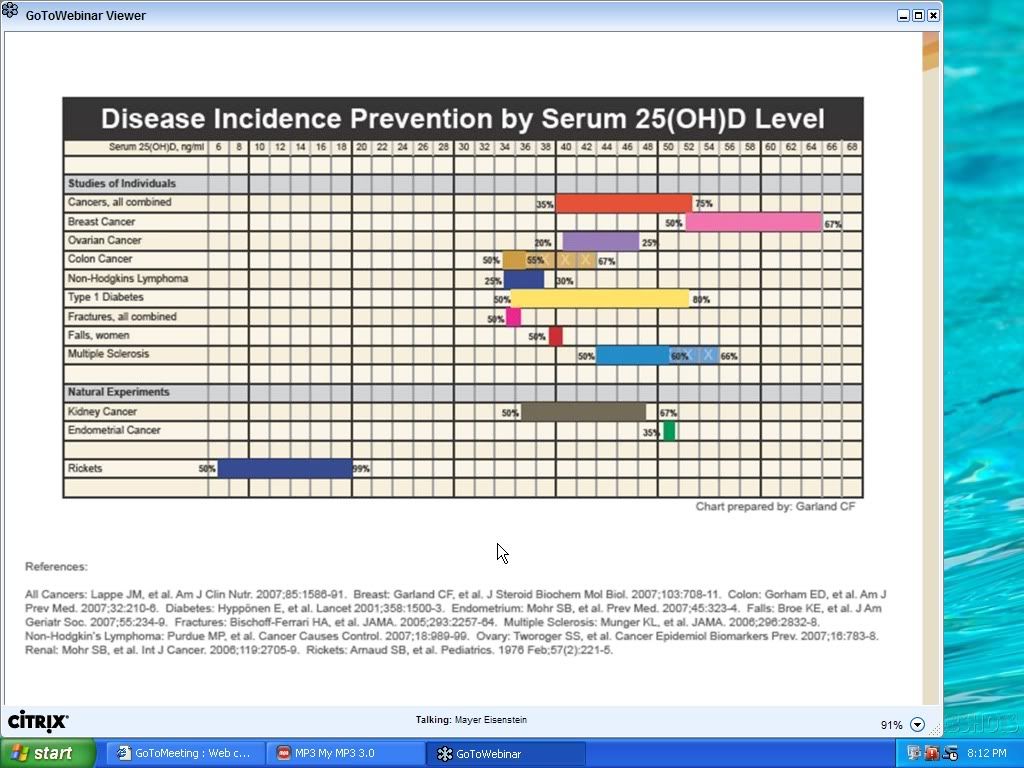
Ideally your Vit. D level should be above 80 ng/ml of blood (nanograms per milliliter) to ward off sickness. How do you find this out? With a blood test, its called 25(OH)D - Vit. D test. Most insurance companies will cover the cost but others will need a diagnosis in order to cover the cost of it. You can also order a home test kit & then send the samples back in for the results. You can find these companies by doing a google search. You can also get a kit from this website.
http://www.zrtlab.com/vitamindcouncil/
How much D3 each day is too much? Can you overdose on it? Worrying about Vitamin D overdosing has lead 90% of America to be Vit. D deficient. This is one of the reasons why Americans get sick so easily. In order to get enough Vit. D each day, you need to spend 15-20 min. each day with 40% body exposure between 10 & 2 pm. I'm not saying stay in the sun until you are burned to a crisp but just this 15-20 min. This is good for about 10,000 IU of Vit. D. You are not going to get sunburned in that short period of time. My husband did it all this past summer on a daily basis & never got sunburned. Have you noticed that the skin cancer rate has gone UP since the widespread use of Sunblocker & Sun Tan lotions? There are a lot of chemicals in those lotions that are quickly absorbed by our bodies within a few minutes of application. A lifeguard who spend 6-8 hours watching swimmers at the pool will get about 50,000 IUs/day. How much Vitamin D3 do you need each day if you don't get enough time in the sun? This chart shows you how much.
http://i226.photobucket.com/albums/dd52/mopar28m/vitd9.jpg

I started taking 2,000 IU of Vit. D3 last Spring after I had foot surgery. I had read that D3 would help the bones heal in the area where they had sliced the bone in the right big toe joint & put pins in. But after hearing a webinar (online seminar)about D3 & how people with chronic conditions should be taking 10,000 IU/day, I immediately upped my dosage. Since I have osteoarthritis, I have continued to take 10,000 IU/day since this falls under the chronic condition category in the chart above.
By now you are probably wondering what D3 & H1N1 have to do with each other. D3 has been shown to be effective against the H1N1 virus. Take a look at this article.
http://archive.constantcontact.com/fs001/1101240076659/archive/1102711304092.html
A long term care facility in Wisconsin used D3 to combat H1N1. I have also seen it work in my own home. Late October my daughter came down with a flu bug that I assumed to be H1N1 after her best friend came back to school too soon after recovering from H1N1. It started on a Saturday & by Wednesday evening, I was pretty sure that she was going to be in the doctors office or the hospital by Saturday. She had posted on her Facebook account that she had H1N1. Dr. Mayer Eisenstein contacted me via Facebook to call him about her. He asked me how much D3 I was giving her in which I replied 10,000 IU/day. He said it wasn't enough. He told me to boost it up to 150,000 IU/day for 7 days. This was Thursday morning, by Friday evening she was really perking up & by Saturday morning she was feeling 99.9% better. That evening I let her go to a party with the promise that she would NOT go outside & would not get real close to anyone. And she kept that promise. By Monday, she was back in school. A month later, she is still taking 10,000 IU/day to get her thru the cold & flu season because of her week immune system.
Fears about Vit. D toxicity are unwarranted. That is why we are so deficient & sickness runs so rampant thru society today.
http://www.vitamindcouncil.org/vitaminDToxicity.shtml
This is a link that Dr. Sherri Tenpenny did on Vit. D. It is highly infomative & I highly recommend you read it.
http://drtenpenny.com/Documents/Vitamin%20D%20and%20You.pdf
I have an exciting announcement that I will let out of the bag very soon. Keep watch here & on Facebook.
Be well,
Lori
Subscribe to:
Posts (Atom)